Films and series set in Abruzzo. And what the Italian sounds like.
43 films and series set here, 9 with their speech described.
- 43 titles set in Abruzzo · click a dot to filter
- 1PescaraPane e tulipani9
- 2ChietiSciopèn2
- 3LancianoIl diario1
- 4SulmonaParenti serpenti1
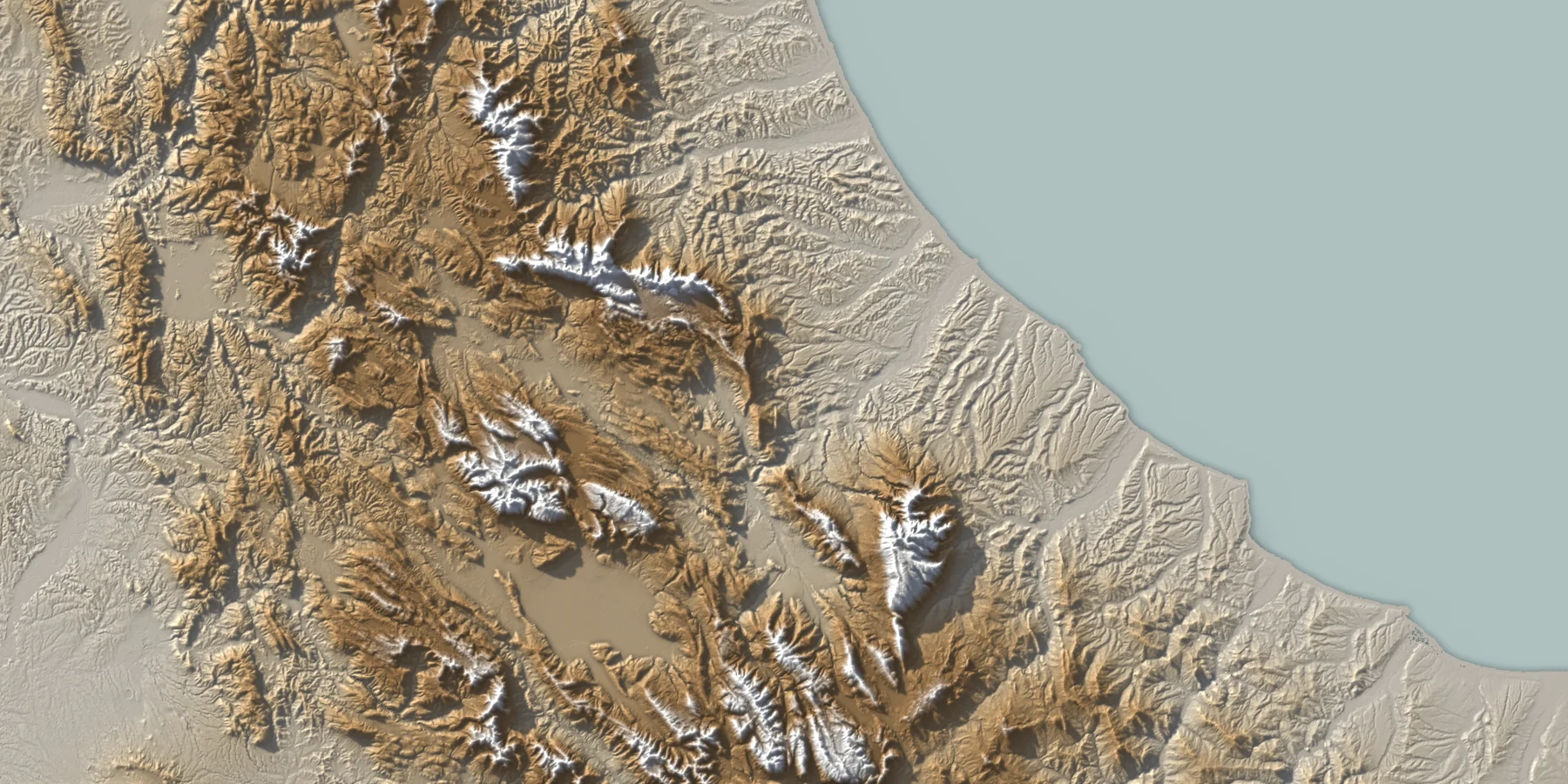
Relief: Copernicus EU-DEM (modified; not endorsed by the European Union) and ETOPO1. Boundaries: Natural Earth. Settings: Wikidata and Italian and English Wikipedia (CC BY-SA 4.0). Sources
The figure is an average per day across the five years to July 2026. Lookups — not viewings, not ticket sales, not streams.
Set here, not shot here. A title is on this page because its record says the story takes place in this region. Where the camera stood is a fact about a production, not about the work, and counting it moves 80 titles onto pages they have nothing to do with.
- #1357avg. daily Wikipedia article visits
The family speaks standard Italian throughout, but each branch carries the accent and a little of the local colouring of where it settled — the Abruzzo home town, Rome, the south — so the marking is audible without ever costing a learner the sense of a line.
Family meals and negotiations are played as collective bickering with people cutting across each other and several voices going at once, well above a calm conversational rate.
- #2323avg. daily Wikipedia article visits
Broadcast-standard Italian throughout, with light Veneto colouring from local characters and the lead's audible Roman accent, but no lines carried in dialect.
Normal conversational tempo with some raised-voice overlap in family and confrontation scenes, but lines are delivered clearly for a mass television audience.
The variety described is not this region’s.
- #3237avg. daily Wikipedia article visits
The Roman teacher and the school bureaucracy speak standard Italian, while the mountain villagers and parents speak standard grammar heavily coloured by Abruzzese accent and local lexicon, with occasional fully local turns played for comic contrast.
Normal conversational speed, with some crosstalk when villagers or pupils talk over each other, but the two leads' exchanges are clearly articulated.
- #4220avg. daily Wikipedia article visits
The Ortona family scenes carry audible Abruzzese accent and local colouring in address terms and interjections, but the grammar stays standard and the Paris/industry scenes are plain standard Italian.
Normal conversational speed, rising to shouted overlap in the brothers' and family arguments but returning to unhurried delivery in the narration and intimate scenes.
- #5194avg. daily Wikipedia article visits
Both storylines are set in and around Naples and the speech is consistently Neapolitan-coloured — local lexicon, interjections and intonation over largely standard grammar — with the singer's entourage and the football dressing room pushing furthest toward true dialect in isolated exchanges.
Normal conversational pace with some overlap in the group scenes, though the singer's boastful monologues run fast and unbroken.
The description names somewhere else, and we have not established which is right.
- #6192avg. daily Wikipedia article visits
Village speech in the central-southern setting is regionally marked and the marshal is written as a Neapolitan, so lexicon and interjections carry strong regional colour, but the grammar stays standard and lines remain followable.
Comic delivery is quick, with the marshal's patter and crowded village exchanges producing frequent interruption, though the era's post-synchronised sound keeps every syllable clearly enunciated.
- #7174avg. daily Wikipedia article visits
Everyone speaks standard Italian; Rosalba and her family carry an Abruzzese colouring and the Venetian characters a local accent, with only scattered regional turns of phrase, no shift out of standard Italian.
Normal conversational speed with some overlap in the family and restaurant scenes, slowed by Fernando's measured, unhurried delivery.
- #8132avg. daily Wikipedia article visits
An ensemble Roman comedy played in standard Italian with Roman cadence throughout, plus Vincenzo Salemme's Neapolitan-coloured delivery in his strand, but nothing that leaves standard grammar or lexicon.
Comic timing pushes the delivery fast, and the couple and family scenes are full of interruption, talking over each other and rapid-fire retorts.
- #986.6avg. daily Wikipedia article visits
- #1083.7avg. daily Wikipedia article visits
Darker means more titles set there.
- Lazio1,228 titles
- Campania516 titles
- Lombardia422 titles
- Sicilia304 titles
- Toscana235 titles
- Emilia-Romagna186 titles
- Piemonte173 titles
- Veneto168 titles
- Puglia105 titles
- Liguria83 titles
- Sardegna53 titles
- Abruzzo43 titles
- Calabria43 titles
- Friuli-Venezia Giulia42 titles
- Umbria42 titles
- Marche36 titles
- Basilicata27 titles
- Trentino-Alto Adige27 titles
- Valle d'Aosta9 titles
- Molise5 titles
Catalogue information may be incomplete. Sources and methodology
Find your starting point. Estimate your Italian vocabulary.
Take the quizFree vocabulary quiz. No signup required.