Films and series set in Lombardia. And what the Italian sounds like.
422 films and series set here, 59 with their speech described.
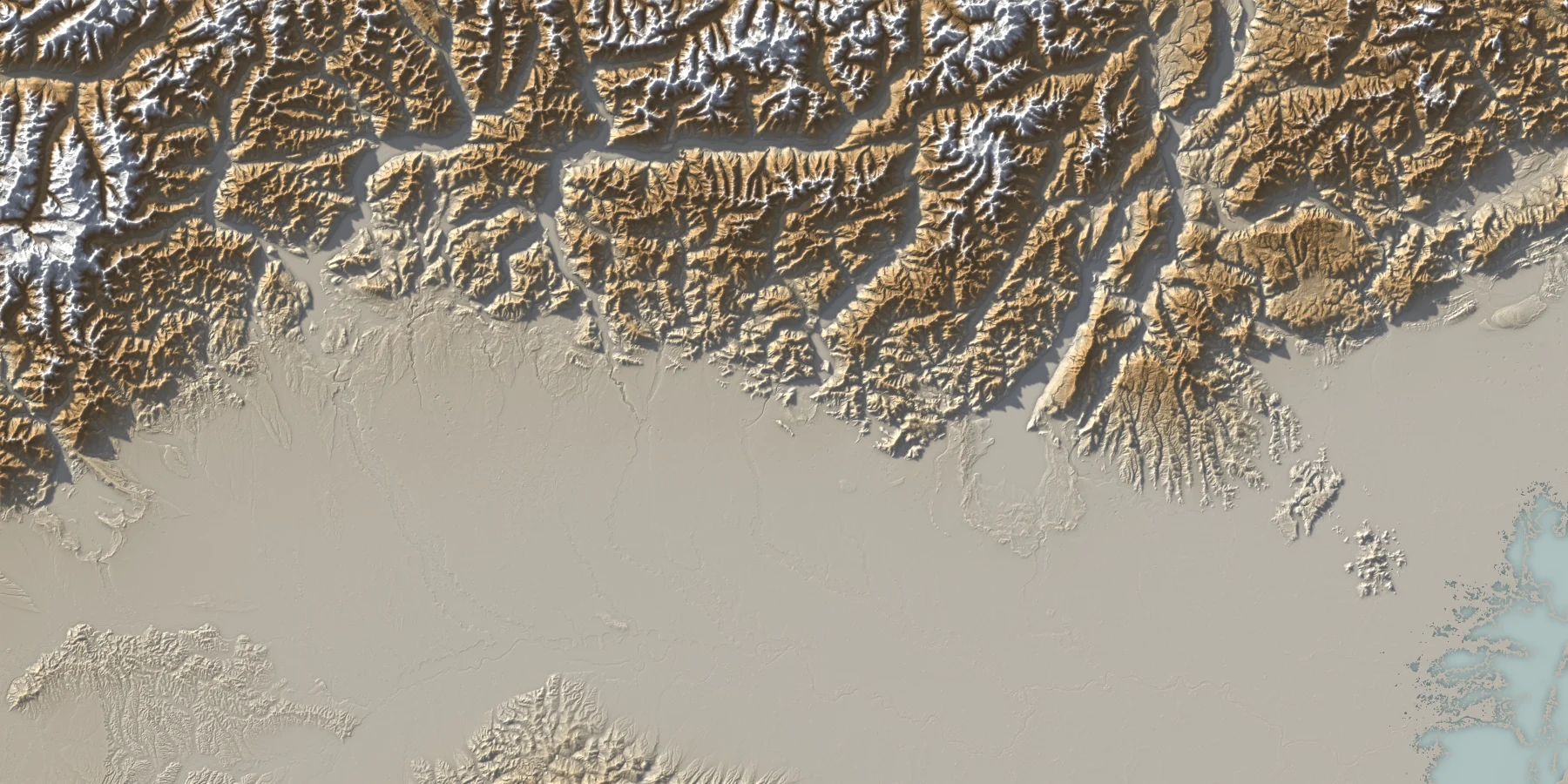
- 422 titles set in Lombardia · click a dot to filter
- 1MilanoDoc - Nelle tue mani327
- 2Lago di ComoI promessi sposi11
- 3LeccoI promessi sposi7
- 4LiernaI promessi sposi7
- 5MantovaMonamour7
- 6PaviaGiovanni Falcone6
- 7BresciaIl magnifico cornuto3
- 8BergamoI nostri mariti2
- 9CremonaLa febbre2
- 10LodiLui è peggio di me2
- 11Castello Visconti di San VitoMarco Visconti1
- 12MonzaLa monaca di Monza1
- 13RescaldinaMarco Visconti1
Relief: Copernicus EU-DEM (modified; not endorsed by the European Union) and ETOPO1. Boundaries: Natural Earth. Settings: Wikidata and Italian and English Wikipedia (CC BY-SA 4.0). Sources
Twelve titles are set in more than one town here and appear under each pill they belong to, so the pills above total 444 against Everywhere's 422.
The figure is an average per day across the five years to July 2026. Lookups — not viewings, not ticket sales, not streams.
Set here, not shot here. A title is on this page because its record says the story takes place in this region. Where the camera stood is a fact about a production, not about the work, and counting it moves 80 titles onto pages they have nothing to do with.
- #11,209avg. daily Wikipedia article visits
A Rai 1 primetime hospital drama set in Milan whose doctors, nurses and patients all speak clean standard Italian, with at most a light northern accent and no dialect exchanges.
Normal conversational Italian, quickened with some cross-talk during emergency and ward-round scenes but generally delivered clearly for a broad primetime audience.
- #2650avg. daily Wikipedia article visits
Everyone speaks standard Italian; the Milanese setting and the southern-born shopgirls bring accents and the odd regional flavour, but the grammar and lexicon stay standard throughout.
Soap delivery is deliberately unhurried and articulated, one speaker at a time, with pauses left for reaction shots and little genuine cross-talk.
- #3584avg. daily Wikipedia article visits
Stated languages: francese, italiano, tedesco
Essentially standard Italian throughout, post-synced with clear declamatory diction; only light northern colouring on some of the younger victims' speech.
Delivery is slow and declamatory, one speaker at a time with the others listening, and almost no cross-talk or interruption.
- #4443avg. daily Wikipedia article visits
The Pavia setting gives the young cast a light northern-Lombard colouring in accent and a few local turns of phrase, but the speech is standard Italian throughout and nothing is spoken as a separate variety.
The comic rhythm depends on the pair talking over each other at speed, with interruptions and rapid-fire exchanges as a running device.
- #5375avg. daily Wikipedia article visits
A Como-set studio soap performed throughout in clear standard Italian with neutral broadcast diction and no local lexicon.
Studio-recorded exchanges are unhurried and clearly articulated, one speaker at a time apart from occasional raised-voice confrontations.
- #6315avg. daily Wikipedia article visits
Checco and his Apulian family and friends speak Italian heavily coloured by Barese lexicon, interjections and intonation, while the Milanese characters he moves among speak plain standard Italian; the comic contrast only works if the audience follows both, so the southern speech stays broadly decodable rather than becoming full dialect.
Normal conversational speed with bursts of faster overlapping talk in the family and party scenes, but the comic timing depends on lines landing clearly, so most exchanges are delivered one speaker at a time.
- #7291avg. daily Wikipedia article visits
The three leads speak standard Italian carried on very strong regional voices — Aldo's Palermitan and Giovanni and Giacomo's Milanese-Lombard — with scattered regional lexicon and dialect tags dropped into otherwise standard sentences, so a learner follows the plot but loses the flavour of the contrast the comedy is built on.
Fast three-way banter with constant interruption and talking over each other, which is the engine of the comedy rather than an occasional effect.
- #8279avg. daily Wikipedia article visits
Prime-time Rai fiction shot on Capri: the cast speaks standard Italian throughout with a Campanian accent and only scattered local colour in the mouths of island characters.
Normal conversational pace with some overlap in family arguments, but written to be followed easily by a broad evening audience.
- #9267avg. daily Wikipedia article visits
The film is set in Milan and its hinterland and is spoken in standard Italian throughout, with light regional colour from police colleagues and southern-origin characters rather than any sustained dialect; the non-Italian speech in the Chinese-community scenes is a separate language, not a variety of Italian.
Much of the speech happens under pressure — panicked exchanges in the car, arguments and radio traffic — with characters cutting across each other and speaking fast.
- #10263avg. daily Wikipedia article visits
The comedy is built on the contrast between Aldo's heavily Sicilian-inflected Italian, with occasional Sicilian lexical and word-order quirks, and the northern speech of the other two, but the grammar stays standard and lines remain followable.
The trio's routines run on fast interruption, talking over each other and comic timing that depends on speed.
Darker means more titles set there.
- Lazio1,228 titles
- Campania516 titles
- Lombardia422 titles
- Sicilia304 titles
- Toscana235 titles
- Emilia-Romagna186 titles
- Piemonte173 titles
- Veneto168 titles
- Puglia105 titles
- Liguria83 titles
- Sardegna53 titles
- Abruzzo43 titles
- Calabria43 titles
- Friuli-Venezia Giulia42 titles
- Umbria42 titles
- Marche36 titles
- Basilicata27 titles
- Trentino-Alto Adige27 titles
- Valle d'Aosta9 titles
- Molise5 titles
Catalogue information may be incomplete. Sources and methodology
Find your starting point. Estimate your Italian vocabulary.
Take the quizFree vocabulary quiz. No signup required.