Films and series set in Puglia. And which are in Apulian.
105 films and series set here, 22 with their speech described.
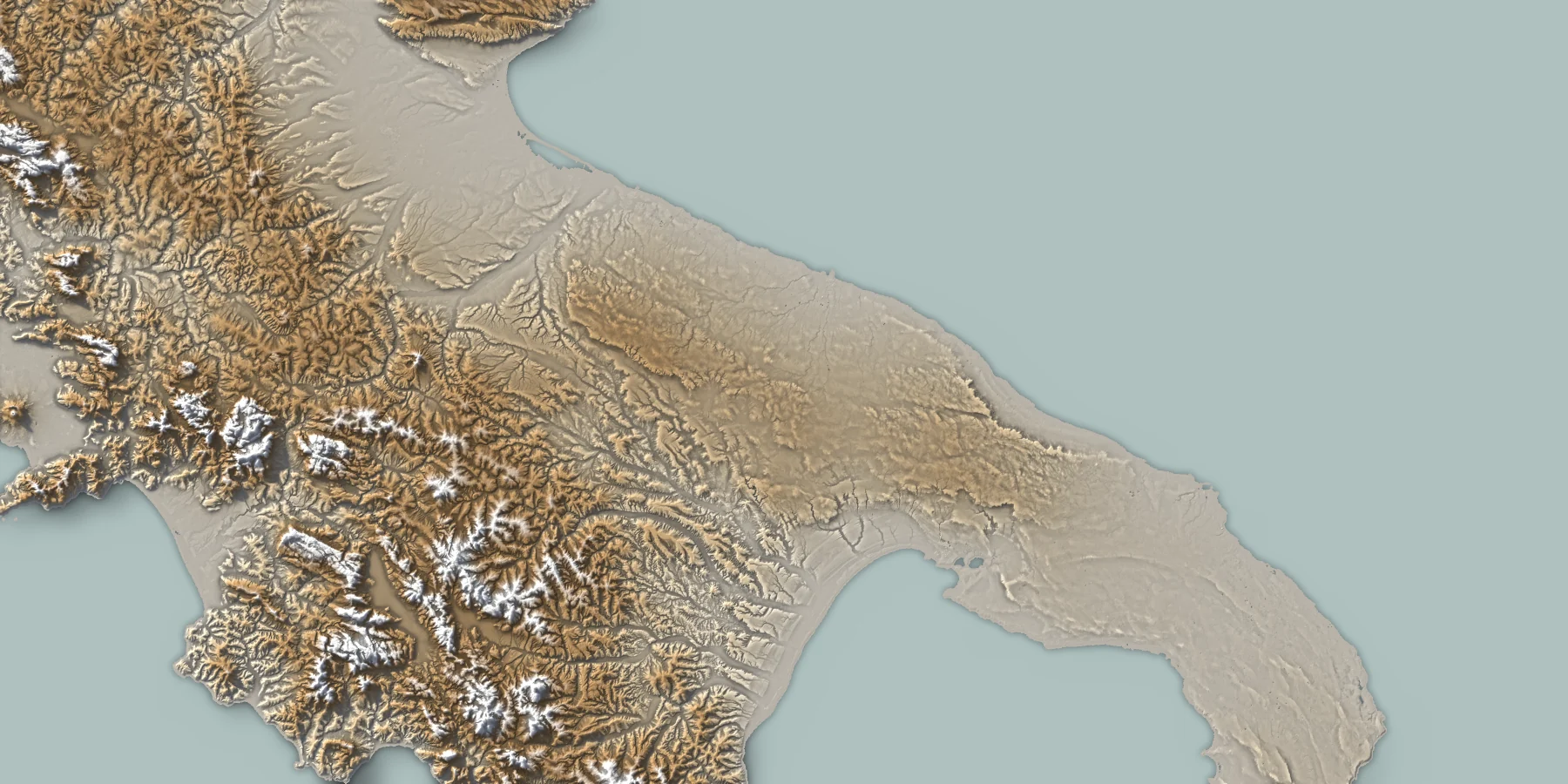
- 105 titles set in Puglia · click a dot to filter
- 1BariLa vita davanti a sé13
- 2LecceAllacciate le cinture2
- 3MonopoliQuasi orfano1
- 4TraniClasse mista1
Relief: Copernicus EU-DEM (modified; not endorsed by the European Union) and ETOPO1. Boundaries: Natural Earth. Settings: Wikidata and Italian and English Wikipedia (CC BY-SA 4.0). Sources
The figure is an average per day across the five years to July 2026. Lookups — not viewings, not ticket sales, not streams.
Set here, not shot here. A title is on this page because its record says the story takes place in this region. Where the camera stood is a fact about a production, not about the work, and counting it moves 80 titles onto pages they have nothing to do with.
- #1476avg. daily Wikipedia article visits
Set in Bari and audibly Apulian: the grammar stays standard and the police work is conducted in standard Italian, but family, market and neighbourhood scenes carry Barese intonation and scattered local words and exclamations.
Normal conversational speed, with faster overlapping cross-talk in the family and market scenes and clearer, slower delivery in the procedural passages.
- #2457avg. daily Wikipedia article visits
Speech is standard Italian throughout with regional colouring — Apulian inflection and occasional local turns from the southern procurer's circle, northern business cadence around Berlusconi — but almost no shift out of standard Italian.
Ordinary conversational speed for the set-piece dialogues, with faster overlapping chatter in the crowded villa and party scenes.
- #3366avg. daily Wikipedia article visits
The Lecce setting gives nearly everyone a strong Salentino accent and the older women in the family colour their speech with local turns of phrase, but the grammar and lexicon stay standard Italian and no scene is carried in dialect.
The family scenes are fast and quarrelsome, with several relatives talking across each other and interrupting, and the group of friends who arrive from Rome adds another layer of rapid banter.
- #4362avg. daily Wikipedia article visits
Checco's Italian is heavily Bari-marked in intonation and carries scattered Apulian lexical and phrasal habits, but the grammar stays standard and the northern/Norwegian-set and institutional characters speak plain Italian, so a learner follows the sense while losing some of the regional colour.
Normal conversational speed with bursts of overlap in family and office arguments; the comic timing actually favours clearly delivered punchlines.
- #5323avg. daily Wikipedia article visits
Broadcast-standard Italian throughout, with light Veneto colouring from local characters and the lead's audible Roman accent, but no lines carried in dialect.
Normal conversational tempo with some raised-voice overlap in family and confrontation scenes, but lines are delivered clearly for a mass television audience.
The variety described is not this region’s.
- #6315avg. daily Wikipedia article visits
Checco and his Apulian family and friends speak Italian heavily coloured by Barese lexicon, interjections and intonation, while the Milanese characters he moves among speak plain standard Italian; the comic contrast only works if the audience follows both, so the southern speech stays broadly decodable rather than becoming full dialect.
Normal conversational speed with bursts of faster overlapping talk in the family and party scenes, but the comic timing depends on lines landing clearly, so most exchanges are delivered one speaker at a time.
- #7296avg. daily Wikipedia article visits
Checco's Italian is strongly Apulian in accent, intonation and word choice, and some southern characters slip further toward Barese, but the grammar stays standard and lines remain followable.
Normal conversational speed with some overlap in the crowded group scenes; the comic delivery leans on timing and pauses rather than relentless cross-talk.
- #8291avg. daily Wikipedia article visits
The three leads speak standard Italian carried on very strong regional voices — Aldo's Palermitan and Giovanni and Giacomo's Milanese-Lombard — with scattered regional lexicon and dialect tags dropped into otherwise standard sentences, so a learner follows the plot but loses the flavour of the contrast the comedy is built on.
Fast three-way banter with constant interruption and talking over each other, which is the engine of the comedy rather than an occasional effect.
- #9262avg. daily Wikipedia article visits
Checco's speech is thickly Apulian — Barese intonation, regional lexicon and local turns of phrase — but the grammar stays Italian, while the Milanese characters and the North African co-lead speak plain standard, so a learner loses colour rather than content.
Normal conversational speed with comic overlap in the family and workplace scenes, but the protagonist's punchlines are delivered slowly enough to land.
- #10245avg. daily Wikipedia article visits
Set in a working-class Bari neighbourhood, the speech is strongly Apulian-inflected with local vocabulary and interjections in family and street scenes, but the grammar stays standard and Rai prime-time norms keep full dialect lines rare.
Normal conversational speed, with overlap rising in the shouted family confrontations but the two-handers between the young leads played slowly and clearly.
Darker means more titles set there.
- Lazio1,228 titles
- Campania516 titles
- Lombardia422 titles
- Sicilia304 titles
- Toscana235 titles
- Emilia-Romagna186 titles
- Piemonte173 titles
- Veneto168 titles
- Puglia105 titles
- Liguria83 titles
- Sardegna53 titles
- Abruzzo43 titles
- Calabria43 titles
- Friuli-Venezia Giulia42 titles
- Umbria42 titles
- Marche36 titles
- Basilicata27 titles
- Trentino-Alto Adige27 titles
- Valle d'Aosta9 titles
- Molise5 titles
Catalogue information may be incomplete. Sources and methodology
10 of the 20 described here are in Apulian. Start with Mine vaganti and leave those until last.
Take the quizApulian is a separate language, not an accent. Free vocabulary quiz. No signup required.