Films and series set in Campania. And which are in Neapolitan.
516 films and series set here, 84 with their speech described.
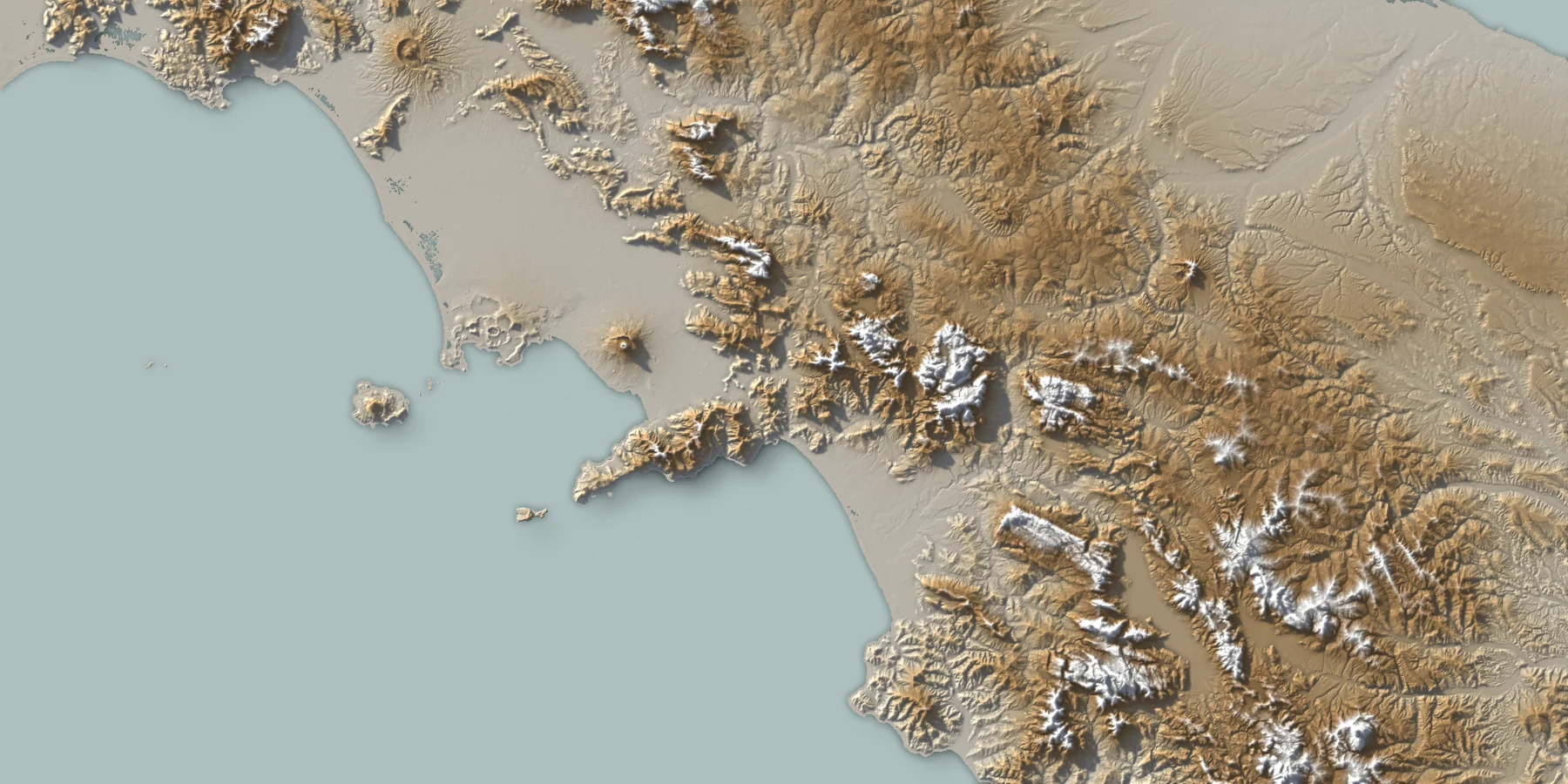
- 516 titles set in Campania · click a dot to filter
- 1NapoliMare fuori450
- 2Isola di CapriIl secondo tragico Fantozzi14
- 3Isola d'IschiaUn'estate al mare11
- 4Torre AnnunziataIl treno dei bambini7
- 5Costiera amalfitanaCapri6
- 6SorrentoPane, amore e...4
- 7PompeiViaggio in Italia3
- 8PozzuoliSabato, domenica e lunedì2
- 9CapuaSpartaco1
- 10MaioriViaggio in Italia1
- 11ProcidaL'isola di Arturo1
- 12SalernoMafia, una legge che non perdona1
Relief: Copernicus EU-DEM (modified; not endorsed by the European Union) and ETOPO1. Boundaries: Natural Earth. Settings: Wikidata and Italian and English Wikipedia (CC BY-SA 4.0). Sources
Nineteen titles are set in more than one town here and appear under each pill they belong to, so the pills above total 539 against Everywhere's 516.
The figure is an average per day across the five years to July 2026. Lookups — not viewings, not ticket sales, not streams.
Set here, not shot here. A title is on this page because its record says the story takes place in this region. Where the camera stood is a fact about a production, not about the work, and counting it moves 80 titles onto pages they have nothing to do with.
- #13,621avg. daily Wikipedia article visits
Stated languages: italiano, lingua napoletana
The young inmates speak Neapolitan to each other as their default language — local lexicon and verb forms, not just accent — while staff and some outsiders use standard Italian, so a learner with only standard Italian loses whole exchanges in the cell blocks.
Group scenes among the teenagers run fast and hot, with interruption, shouting over one another and overlapping cross-talk; the one-on-one counselling scenes are the slow exception.
- #21,349avg. daily Wikipedia article visits
Stated languages: italiano, lingua napoletana
The clans, their families and nearly everyone in the Secondigliano/Scampia world speak Neapolitan as a language rather than accented Italian, and the series was broadcast with Italian subtitles for Italian viewers outside Campania.
Confrontations, family arguments and street exchanges come fast and clipped, with interruption and speakers talking over each other, and lines are often muttered or swallowed rather than articulated.
- #31,002avg. daily Wikipedia article visits
Stated languages: italiano, lingua napoletana
The rione characters speak Neapolitan among themselves as their ordinary language — lexicon and grammar, not accent — to the point that Italian broadcast carried subtitles, while school, teachers and the adult narration sit in standard Italian.
Family and neighbourhood scenes are shouted and overlapping, with several people cutting across each other, though the narration and the two girls' quieter conversations slow it down.
- #4837avg. daily Wikipedia article visits
Stated languages: inglese, italiano, lingua napoletana
Most of the film is standard Italian with a Neapolitan accent, but several Naples-set scenes — the camorra household, street and family exchanges — shift into genuinely Neapolitan lexicon and turns of phrase that a learner will lose in patches.
Lines are delivered slowly and with weight, one speaker at a time, with pauses built into the performances; overlap is rare outside a few family scenes.
- #5830avg. daily Wikipedia article visits
The Schisa family and the wider Neapolitan cast slide constantly between standard Italian and Neapolitan proper — not just accent but local lexicon and verb forms — and a learner with standard Italian will lose whole lines in the family gatherings and street scenes, while the more reflective one-to-one scenes stay closer to standard.
The extended family scenes — the lunch on the terrace, the seaside outing, the hospital and funeral aftermath — run on shouted, overlapping, interrupting cross-talk with several voices at once.
- #6682avg. daily Wikipedia article visits
Set in Naples and regionally marked throughout — Neapolitan accent, interjections and local lexicon from the older working-class characters and the palazzo's caretakers — but the grammar stays standard and full dialect lines are brief and occasional.
Normal conversational speed with some family cross-talk in the group scenes, but daytime-broadcast delivery keeps articulation clear and speakers mostly take turns.
- #7612avg. daily Wikipedia article visits
Stated languages: italiano, lingua napoletana
The squad and its Naples setting carry heavy Neapolitan colouring — witnesses, neighbours and some of the team drop into local lexicon and set phrases — but the police work itself is conducted in standard Italian, and Lojacono's Sicilian origin keeps the lead speaking a neutral variety.
Normal conversational speed, with bursts of overlap when the team bickers or a scene turns into a shouted domestic confrontation, but scenes are staged for clarity as prime-time television.
- #8497avg. daily Wikipedia article visits
Ricciardi and the bourgeois/professional characters speak standard Italian, but Brigadiere Maione, the tenement neighbours, the housekeeper and the informant world of the Neapolitan quarters speak actual Neapolitan, and a learner with standard Italian loses whole exchanges there.
Deliberate, atmospheric delivery with pauses for Ricciardi's brooding, though the Maione household and street scenes bring ordinary overlapping family cross-talk.
- #9311avg. daily Wikipedia article visits
Enzo, Zingaro and the Roman criminal milieu speak thick borgata romanesco throughout — not just an accent but local lexicon, truncated verbs and negation, and consonant weakening that costs a learner with standard Italian whole lines; only a few outsider figures and broadcast fragments sit in standard.
Zingaro's manic, escalating rants and the shouted gang confrontations run fast with frequent interruption and talking over each other, and Alessia's disordered rapid speech adds another layer of hard-to-parse delivery.
- #10299avg. daily Wikipedia article visits
Rome-set and Roman-accented throughout, with occasional romanesco colouring in the friends' banter, but the grammar and lexicon stay standard and no local variety carries a line.
Characters shout over each other in the quarrel and dinner-table scenes, with fast delivery and frequent interruption typical of this director's ensembles.
The description names somewhere else, and we have not established which is right.
Darker means more titles set there.
- Lazio1,228 titles
- Campania516 titles
- Lombardia422 titles
- Sicilia304 titles
- Toscana235 titles
- Emilia-Romagna186 titles
- Piemonte173 titles
- Veneto168 titles
- Puglia105 titles
- Liguria83 titles
- Sardegna53 titles
- Abruzzo43 titles
- Calabria43 titles
- Friuli-Venezia Giulia42 titles
- Umbria42 titles
- Marche36 titles
- Basilicata27 titles
- Trentino-Alto Adige27 titles
- Valle d'Aosta9 titles
- Molise5 titles
Catalogue information may be incomplete. Sources and methodology
60 of the 82 described here are in Neapolitan. Start with Capri and leave those until last.
Take the quizNeapolitan is a separate language, not an accent. Free vocabulary quiz. No signup required.