Films and series set in Emilia-Romagna. And what the Italian sounds like.
186 films and series set here, 47 with their speech described.
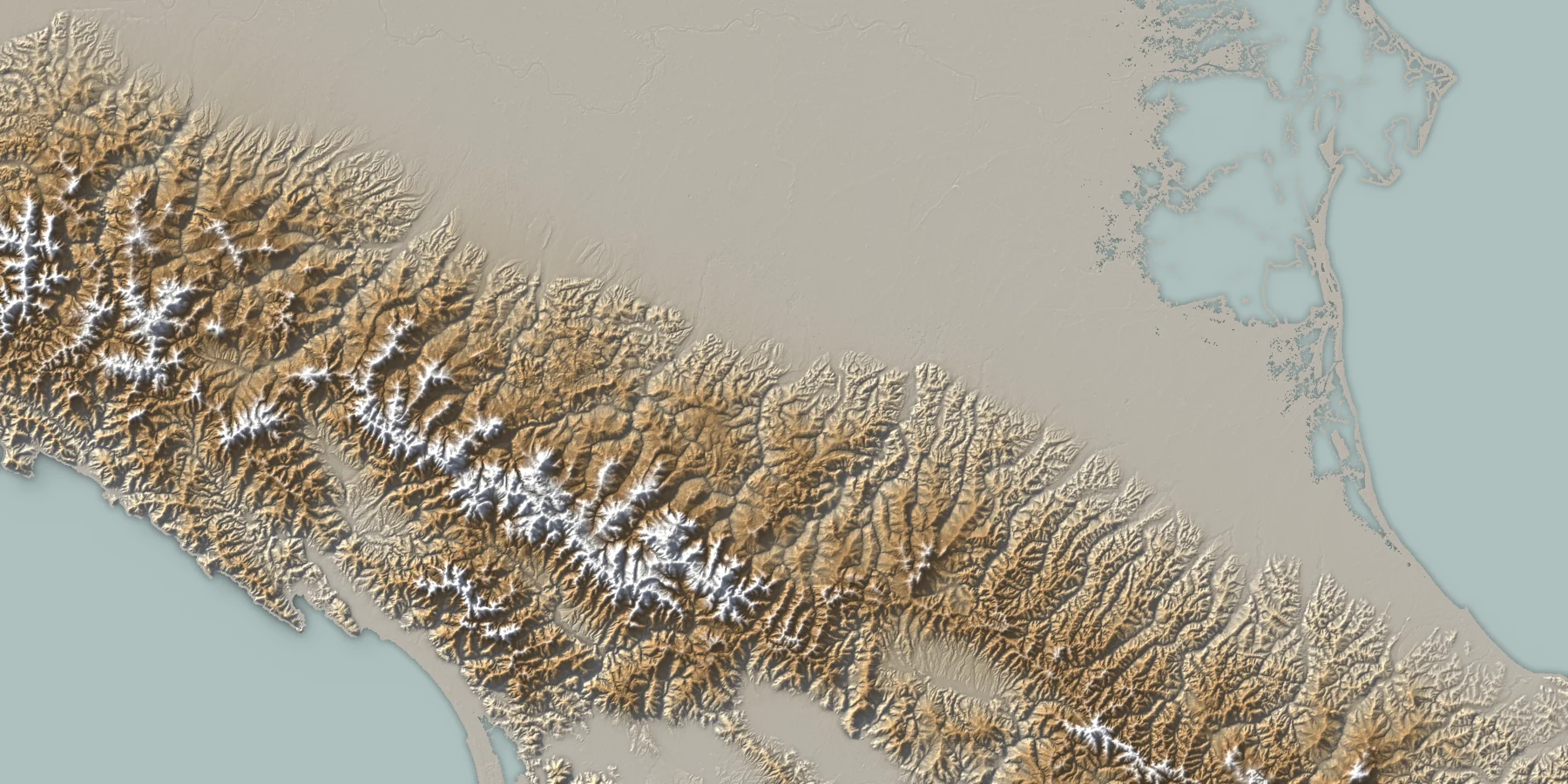
- 186 titles set in Emilia-Romagna · click a dot to filter
- 1BolognaL'ispettore Coliandro49
- 2FerraraLea16
- 3RiminiL'ispettore Coliandro13
- 4ParmaTifosi10
- 5ModenaGomorra - La serie8
- 6RiccioneSotto il sole di Riccione5
- 7Faenza40 gradi all'ombra del lenzuolo3
- 8RavennaLa ragazza di latta1
Relief: Copernicus EU-DEM (modified; not endorsed by the European Union) and ETOPO1. Boundaries: Natural Earth. Settings: Wikidata and Italian and English Wikipedia (CC BY-SA 4.0). Sources
Four titles are set in more than one town here and appear under each pill they belong to, so the pills above total 190 against Everywhere's 186.
The figure is an average per day across the five years to July 2026. Lookups — not viewings, not ticket sales, not streams.
Set here, not shot here. A title is on this page because its record says the story takes place in this region. Where the camera stood is a fact about a production, not about the work, and counting it moves 80 titles onto pages they have nothing to do with.
- #11,349avg. daily Wikipedia article visits
Stated languages: italiano, lingua napoletana
The clans, their families and nearly everyone in the Secondigliano/Scampia world speak Neapolitan as a language rather than accented Italian, and the series was broadcast with Italian subtitles for Italian viewers outside Campania.
Confrontations, family arguments and street exchanges come fast and clipped, with interruption and speakers talking over each other, and lines are often muttered or swallowed rather than articulated.
The description names somewhere else, and we have not established which is right.
- #2821avg. daily Wikipedia article visits
Prime-time Rai family fiction written in clean standard Italian throughout; a few characters carry a central or Roman accent and the odd colloquial regionalism, but nothing that changes the grammar or blocks a line.
Normal Italian conversational speed, deliberately clear for a broad prime-time audience, with overlap mainly in the comic group scenes rather than as a style.
- #3587avg. daily Wikipedia article visits
Set in Bologna and shot with local colour, but everyone speaks standard Italian with Emilian or southern-inflected accents rather than dialect; only stray regional turns of phrase appear.
Comic-crime rhythm with fast delivery, characters talking over one another and frequent shouted interruptions in the station and on the street.
- #4584avg. daily Wikipedia article visits
Stated languages: francese, italiano, tedesco
Essentially standard Italian throughout, post-synced with clear declamatory diction; only light northern colouring on some of the younger victims' speech.
Delivery is slow and declamatory, one speaker at a time with the others listening, and almost no cross-talk or interruption.
- #5339avg. daily Wikipedia article visits
Stated languages: greco antico, italiano
The Rimini townspeople speak a heavily Romagnol-inflected Italian with local lexicon, nicknames and interjections, and several characters drift far enough into dialect that a learner with standard Italian loses whole exchanges.
The family dinner and crowd scenes are built on shouting, interruption and several people talking at once, and the comic set pieces run fast.
- #6289avg. daily Wikipedia article visits
The bulk of the film is in a formal period Italian, but the Mortara household and Bologna street scenes carry Emilian-inflected speech and the Roman clerical world adds local colour, so grammar stays standard while some lexicon and address forms are regionally and communally marked.
Clerical and courtroom exchanges are measured and declamatory, while the family's scenes of protest and grief bring ordinary conversational speed and some overlapping shouting.
- #7279avg. daily Wikipedia article visits
Stated languages: inglese, italiano
The braccianti and farmhands of the Po valley estate speak Italian coloured by Emilian lexicon and cadence, while the landowning family and the political set speak standard — followable throughout, with occasional peasant lines that lean local.
Normal conversational pace, with some overlap in the crowded farmhouse and crowd scenes but generally one speaker delivering at a time.
- #8277avg. daily Wikipedia article visits
Speech is standard Italian throughout, with light Emilian-Romagnolo colouring in the Bologna and Rimini scenes and regional accents on some secondary characters, but no shift out of standard Italian.
Brisk comic delivery with characters talking over each other in the group scenes and in the government meetings, faster than an unhurried conversational baseline.
- #9243avg. daily Wikipedia article visits
The speech is standard Italian throughout — provincial Emilian and Roman settings give some accent and light regional colour, but nothing a learner with standard Italian loses.
Amelio stages the dialogue deliberately, with characters finishing their sentences; overlap appears mainly in the crowded courtroom and newsroom scenes.
- #10239avg. daily Wikipedia article visits
Spoken in clean standard Italian throughout, with at most light northern colouring from the Ferrara setting.
Normal conversational pace with clear articulation typical of prime-time Rai fiction; overlap is limited and lines are delivered to be understood.
Darker means more titles set there.
- Lazio1,228 titles
- Campania516 titles
- Lombardia422 titles
- Sicilia304 titles
- Toscana235 titles
- Emilia-Romagna186 titles
- Piemonte173 titles
- Veneto168 titles
- Puglia105 titles
- Liguria83 titles
- Sardegna53 titles
- Abruzzo43 titles
- Calabria43 titles
- Friuli-Venezia Giulia42 titles
- Umbria42 titles
- Marche36 titles
- Basilicata27 titles
- Trentino-Alto Adige27 titles
- Valle d'Aosta9 titles
- Molise5 titles
Catalogue information may be incomplete. Sources and methodology
Find your starting point. Estimate your Italian vocabulary.
Take the quizFree vocabulary quiz. No signup required.